The best trampoline is not a single model. It is the option that fits the intended user, the way it will be used, the available space, and the amount of setup and maintenance the household can realistically manage.
That distinction matters because a compact rebounder, a small handled trampoline, and a full-size backyard trampoline solve very different problems. Comparing them as though they belong on one ranked list usually creates more confusion than clarity. A better approach is to make the major decisions in order, then compare exact products only after the unsuitable categories have been removed.
What 'best' should mean for your household
Start with four questions:
- Who is the intended user?
- Is the main purpose individual exercise, compact indoor activity, or outdoor recreation?
- Where will the trampoline remain while it is being used?
- Who will assemble, inspect, store, and maintain it?
These questions are more useful than a long feature list. If the main goal is individual exercise in a limited indoor area, a full-size outdoor trampoline is not a meaningful comparison. If the goal is backyard recreation, a foldable rebounder is not a substitute. If the household cannot provide the required space or supervision, the right outcome may be to postpone the purchase rather than force a poor fit.
Treat “best” as a match, not a trophy. The strongest candidate is the one that meets the actual use case with the fewest unresolved compromises.
Choose the trampoline type before the model
Most shoppers can narrow the field quickly by choosing among three broad paths: an exercise-focused rebounder, a compact format intended for a younger user, or a full-size outdoor trampoline. The category choice determines which later details deserve attention.
Do not begin with maximum capacity, accessory count, or a promotional label. First decide what the trampoline needs to do. Then use specifications to confirm that a particular product can do that job in the available setting.
Fitness rebounders for individual exercise
A fitness rebounder is the logical starting point when the intended use is individual indoor exercise and floor space is limited. Compare the total footprint, jumping surface, frame shape, spring or bungee system, handle design, folded dimensions if storage matters, and the amount of open space needed during use.
The handle should be evaluated as part of the intended exercise setup, not as proof that the product is suitable for every user. Check its adjustment range, how it changes the footprint, and whether the selected configuration can be stored where planned. Avoid choosing by a stated maximum capacity alone; overall fit also depends on the exact dimensions, setup, and instructions.
Compact and kids formats
For a younger user, begin with the exact product format rather than the word “kids.” A compact handled trampoline, a foldable design, and an enclosed design are not interchangeable. Compare the intended use stated by the manufacturer, the usable area, total footprint, padding and enclosure layout, access opening, user limit, and adult-supervision requirements.
Do not infer age suitability or shared-use permission from a category name, product photo, or size label. Check the instructions for the exact product and configuration. If those instructions are unclear or internally inconsistent, do not fill the gap with a general rule.
Full-size backyard trampolines
A full-size backyard trampoline creates the largest planning burden. The product must fit not only within the yard boundary but also within a suitable setup area with surrounding and overhead clearance. Assembly access, supervision, weather exposure, inspection, and off-season care all belong in the purchase decision.
A larger diameter is not automatically better. More size also means a larger footprint and a more demanding setup. Choose the smallest size that still suits the intended use after the exact product instructions and the site have both been checked.
Measure the space before choosing a size
Measure the real location, not an estimated patch of floor or lawn. Record the maximum usable width and depth, the overhead space, the path through which boxed components must travel, and any fixed obstacles. For indoor use, include ceiling fixtures, fans, furniture, doors, and the extra footprint created by a handle. For outdoor use, include fences, trees, structures, play areas, overhead lines, and water.
Government safety guidance recommends reading the manufacturer instructions, using flat and level ground for a backyard trampoline, and locating it away from structures, trees, fences, overhead lines, water, and other hazards.
As a specific planning reference, Health Canada recommends at least 2 metres of clearance around the sides of a backyard trampoline and 8 metres of overhead space. Treat those figures as attributed Canadian guidance, not as a replacement for the instructions supplied with the exact product.
Before shopping, write down:
- maximum usable width and depth;
- available overhead space;
- surface type and levelness;
- nearby fixed and overhead hazards;
- access route for assembly;
- storage space, if the product will be moved or folded; and
- the clearance required by the exact manufacturer instructions.
If a candidate only fits when a required clearance is ignored, it does not fit.
Compare features by the job they need to do
Feature comparisons become easier when each feature has a defined job.
| Feature | Question to ask |
|---|---|
| Springs or bungees | Does the system suit the intended format, and what inspection or replacement work does it require? |
| Frame shape and size | Does the complete footprint fit the measured location? |
| Handle | Is it appropriate for the intended individual-use setup, and does its range fit the user? |
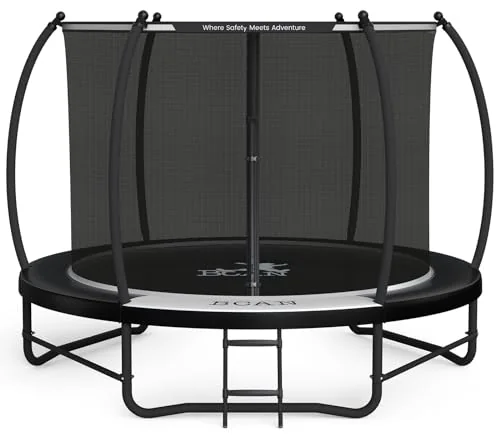
| Enclosure | How is it attached, entered, closed, and inspected? |
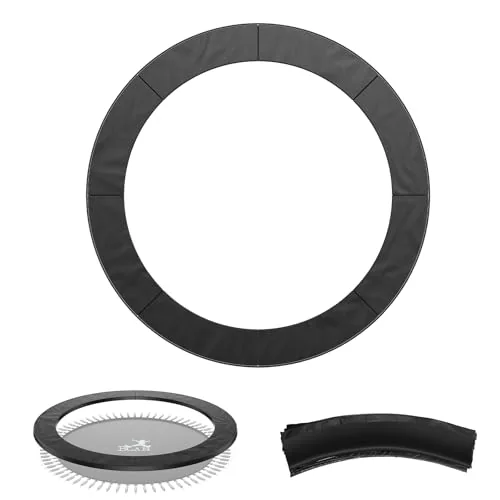
| Padding | Does it cover the areas identified in the product instructions, and can it be inspected or replaced? |
| Foldability | Can the product actually be folded, moved, and stored by the household? |
| Accessories | Are they relevant to the use case, or are they simply increasing complexity? |
Do not translate a different mechanism into an unsupported performance conclusion. “Spring” and “bungee” describe systems; they do not, by themselves, prove that one product is better for every user. The same principle applies to frame shape, padding thickness, pole shape, and accessory count.
CPSC guidance says trampoline enclosures can help prevent injuries from falls, while pediatric evidence cautions that enclosures and supervision do not eliminate injury risk. An enclosure is therefore a feature to inspect and use correctly, not a safety guarantee or proof that one product is universally safer than another.
Check the safety constraints before you buy
Safety instructions should influence the purchase before the box arrives. If the location, supervision plan, user behavior, or maintenance commitment does not fit the required conditions, a product’s feature list cannot solve the mismatch.
For recreational trampolines, CPSC and Health Canada recommend active adult supervision for children and only one jumper at a time. Supervision is an ongoing responsibility; it should not be treated as a one-time setup task or a substitute for following the product instructions.
CPSC advises that children younger than 6 should not use a full-size trampoline. Keep the “full-size” qualifier: this statement should not be turned into a universal rule for every compact, toddler, or mini format. Suitability for any exact product still needs to be checked against its instructions.
Official guidance also recommends regular inspection, keeping pads and components intact, and avoiding use in high winds or unsuitable weather. This means condition and weather exposure belong in the buying decision, especially when a trampoline will remain outdoors.
A practical pre-purchase safety check is simple:
- Can the household enforce one-jumper use where that guidance applies?
- Is active adult supervision realistic every time a child uses it?
- Is the proposed location level and separated from hazards?
- Can the product be inspected before use and after severe weather?
- Are damaged or missing components likely to be noticed and replaced promptly?
- Do the exact age, user, capacity, assembly, anchoring, and weather instructions match the intended situation?
If several answers are uncertain, resolve them before choosing a product.
Understand what precautions cannot guarantee
It is important to distinguish risk reduction from risk elimination. CPSC says enclosures can help prevent fall injuries, but Canadian pediatric guidance states that enclosures and supervision are no guarantee against injury.
Health Canada reports that the Canadian Paediatric Society and Parachute Canada recommend against recreational home trampolines because of the potential for serious injury. A Canadian Paediatric Society position statement likewise advises against home recreational trampoline use. This is the stated position of those named Canadian organizations, not a universal legal prohibition, but it is material context for a household deciding whether to buy a backyard trampoline.
The decision is therefore not only “Which model?” It is also “Is a recreational home trampoline an acceptable choice for this household after the remaining risk is understood?”
Evaluate the work after purchase
The purchase price is only one part of ownership. Before buying, identify who will assemble the trampoline, where the instructions will be kept, how the product will be inspected, what will happen during unsuitable weather, where removable or foldable components will be stored, and how replacement components will be matched to the exact product.
For backyard trampolines, government guidance emphasizes following the manufacturer instructions and using a suitable level location away from nearby hazards.
Official guidance also calls for regular component inspection and avoiding use in high winds or unsuitable weather.
Add these checks to the shortlist:
- Are the full instructions available before purchase?
- Is the assembly area large enough for the complete process, not just the finished footprint?
- Which components need routine inspection?
- What does the manufacturer require for wind, weather, anchoring, moving, or storage?
- Are replacement pads, nets, springs, bungees, hardware, or other wear items identifiable for the exact model and size?
- What warranty exclusions or maintenance duties should be understood before purchase?
Do not assume that a generic accessory name guarantees compatibility. Confirm model, dimensions, attachment points, and the manufacturer’s compatibility information before ordering a replacement.
Build a shortlist and verify the exact product
At this point, the shortlist should contain products from only one relevant category. Compare those exact candidates side by side using the same fields:
- intended user and purpose;
- complete product and usable-area dimensions;
- required surrounding and overhead space;
- exact user, age, and capacity instructions;
- spring or bungee system;
- handle, enclosure, padding, and access design;
- assembly, inspection, weather, storage, and replacement-component requirements; and
- the unresolved compromises for the household.
Open the current product page and instructions for each finalist. Verify the selected size or configuration rather than relying on a family-level description. If the information required for a safe and practical decision is missing, contact the manufacturer or choose a candidate with clearer documentation.
The best trampoline is the one that survives this process. It should fit the real use case and location, carry instructions the household can follow, and leave no important safety or ownership question hidden behind a long feature list.