Trampoline safety starts with an uncomfortable fact: no checklist, enclosure, pad, or supervising adult can remove every injury risk. The American Academy of Pediatrics (AAP) strongly discourages recreational trampoline use at home and treats professionally supervised training as a different setting. If a household still permits jumping, the measures in this guide should be understood as ways to address particular hazards—not as a way to make trampoline use risk-free.
Key takeaways
- The AAP discourages recreational home trampoline use; allowing it is a risk decision, not simply an equipment decision.
- Permit only one jumper at a time. Multiple simultaneous users create collision and double-bounce hazards.
- Do not allow flips or somersaults during recreational use. Falls and bad head or neck landings can cause severe injury.
- Children should have active adult supervision and clear rules, but supervision cannot eliminate the underlying risk.
- Treat padding and an enclosure as limited controls, not proof that a trampoline is safe.
Are Trampolines Safe?
For children using a trampoline recreationally at home, the AAP’s answer is cautionary: its policy strongly discourages home use. The same policy discusses competitive sport and structured training separately because those settings may use professional coaching and specialized equipment. The AAP’s family guidance, updated September 3, 2024, continues to advise keeping children away from trampolines except in professionally coached settings.
That position matters because the question is not whether a trampoline has safety features. It is whether a household accepts a remaining risk after applying reasonable precautions. AAP policy notes that available safety measures had not appeared to reduce overall risk substantially, and AAOS guidance warns that an enclosure alone cannot prevent injuries because many happen on the jumping surface.
This guide therefore has a narrow purpose: help readers understand the main hazards and apply a consistent routine if trampoline use is still allowed. It does not certify an activity, setting, or product as safe.
What the Injury Data Actually Shows
Injury figures are useful only when their population and dates remain attached. Two U.S. studies answer different questions.
A study using the U.S. National Electronic Injury Surveillance System estimated 800,969 trampoline injuries among people younger than 19 from 2009 through 2018. In that estimated total, fractures represented 34%, strains or sprains 33%, and 4.6% of patients were admitted to a hospital. These are historical ten-year estimates, not a current annual injury count.
A separate study examined pediatric hospital discharges during 2019 rather than all emergency-department injuries. It identified 885 U.S. discharges involving trampoline injury. Within that hospitalized cohort, upper-limb fractures were the most common injury type, and 13.2% had at least one injury the study classified as serious: intracranial, spinal, internal-organ injury, or paralysis. That 13.2% applies to hospitalized cases in the 2019 dataset; it should not be generalized to everyone who uses a trampoline or everyone treated for an injury.
Together, the studies establish that trampoline injuries range from common musculoskeletal injuries to less common but serious outcomes. They do not provide a simple present-day probability for any individual jumper.
How Serious Injuries Happen
The clearest trampoline safety rules address recognizable injury mechanisms rather than vague advice to “be careful.”
Multiple simultaneous jumpers can collide, and one person’s landing can produce a double bounce that throws another jumper off balance. AAP policy identifies multiple users as the setting for most trampoline injuries, while CPSC, AAP, and AAOS guidance consistently recommends one jumper at a time.
Falls and attempted flips or somersaults create a different concern: an uncontrolled landing on the head or neck. AAP policy links cervical-spine injuries to falls from the trampoline and attempts at somersaults or flips. CPSC warns that a head or neck landing can cause paralysis, and both AAP and AAOS guidance tell recreational users not to attempt these maneuvers.
The practical priority is straightforward: reduce unpredictable interactions between jumpers and remove recreational maneuvers with potentially severe landing consequences.
Decide Who Should Jump—and Where
Before checking springs or zipping a net, decide whether the person and setting fit the guidance at all.
For age, follow the recommendation rather than treating a birthday as a safety threshold. Current AAP family guidance says children under 6 should not jump, and AAOS guidance says children younger than 6 should not use a trampoline. Turning 6 does not mean trampoline use becomes safe; it only moves the child outside that specific age-based recommendation.
Professionally coached training is not equivalent to backyard play. Structured gymnastics or diving programs may use trained instruction, frequent equipment inspections, spotters, and harnesses for advanced skills. Those controls explain why professional training is discussed separately, but they do not make structured activity risk-free.
Avoid a one-line verdict that trampoline parks are always safer or always more dangerous than home trampolines. AAP family guidance cites evidence of a greater likelihood of surgery among people injured at parks, while a 2019 hospitalization study warns that injury location was recorded in only 27% of its cases, limiting location comparisons. Different studies measure different outcomes and populations, so the useful question is what controls exist in the specific setting—not which label sounds safer.
Supervision Is a Control, Not a Guarantee
Active supervision means more than being somewhere nearby. CPSC says adults should supervise children and establish ground rules; AAP and AAOS guidance likewise call for a watching adult who provides instruction and enforces safer-use measures.
The adult’s job is to stop unsafe behavior, control access, and end the session when a rule or equipment check fails.
Even careful supervision cannot control every landing or remove the forces involved in jumping, so it should never be described as a guarantee against injury.
If an adult cannot give the session full attention or cannot enforce one-jumper and no-flips rules, the session should not begin.
Set Up the Area and Control Access
Site and equipment checks address contact hazards, falls, and unsupervised use. They are best completed before a child is waiting to jump.
For a home trampoline, CPSC says to place it away from trees. AAP guidance expands that precaution to walls, buildings, and other play areas and recommends installing the jumping surface as close to the ground as possible. AAOS also recommends ground-level placement. These sources do not provide one universal clearance distance, so use the exact product instructions and applicable local requirements for measurements.
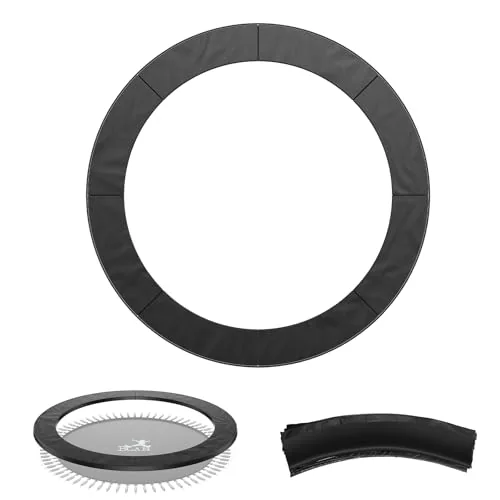
Hard components should not be exposed. CPSC calls for shock-absorbing pads that completely cover the springs, hooks, and frame. AAP and AAOS guidance also call for protective padding around springs, support bars, and other hard surfaces, with the padding correctly positioned and in good condition.
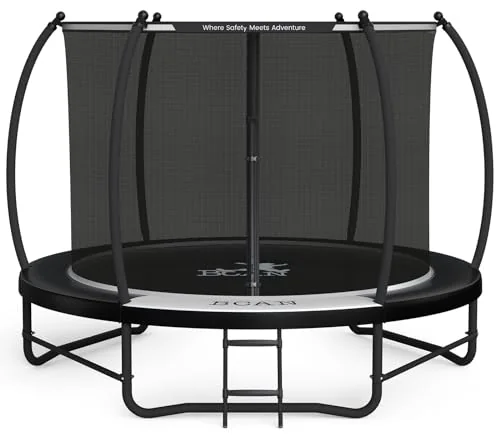
An enclosure can help prevent falls, but only when it is intact and closed during use. CPSC describes a net as a way to help reduce fall injuries, while AAP guidance says to keep it zipped and inspect it for tears or separated seams. AAOS specifically warns against relying on the enclosure alone because many injuries occur on the mat.
Control access when the trampoline is not being used. AAP and AAOS guidance recommend removing the ladder so that young children cannot climb on without supervision. A removed ladder is one layer of control; it does not replace supervision or secure household access rules.
Use a Before-Each-Session Safety Check
The most useful trampoline safety checklist is short enough to repeat every time and strict enough to stop a session when something is wrong.
Before anyone jumps
- Scan the area. Confirm that the trampoline remains at the intended ground-level location and that the surrounding area has not gained a new hard obstacle or overhead hazard.
- Check the pads. Make sure padding is present, correctly positioned, and covering the springs, hooks, frame, support bars, and other hard surfaces identified in the instructions.
- Inspect the enclosure. Look for tears, holes, detached areas, or failed seams, and confirm that the entrance can close during use.
- Inspect the rest of the equipment. Look for worn, torn, damaged, or detached components. Do not allow jumping until affected safety parts are repaired or replaced.
- Control access. Keep young children from climbing on unsupervised; remove the ladder when the trampoline is not in use.
A checklist cannot replace the manufacturer’s instructions. AAP guidance says to check pads and netting every time children jump and to replace worn safety elements before allowing them back on. AAOS recommends regular checks for tears, detached pieces, and wear, and says worn equipment should be discarded when replacement parts are unavailable.
For conditions that vary by product—such as anchoring details or weather limits—follow the instructions for the exact trampoline rather than applying a universal threshold.
Set Rules That Are Easy to Enforce
Long rule lists are difficult to remember. Start with the rules most consistently supported by independent safety and medical guidance.
- One jumper at a time. This reduces collisions and double-bounce interactions between users.
- No flips or somersaults during recreational use. An uncontrolled head or neck landing can have severe consequences.
- An adult actively supervises every session. The adult explains the rules, controls access, and stops the session when a rule is broken.
State the rules before the session begins, not after risky behavior starts. If a rule cannot be enforced consistently, end the session instead of negotiating while someone is still jumping.
What Safety Features Cannot Do
Safety features are useful when their limits are understood.
Padding addresses contact with hard components, and an intact enclosure can help reduce falls from the jumping surface. Neither feature controls every bad landing, collision, double bounce, or injury that occurs on the mat.
Likewise, adult supervision can improve rule enforcement without changing trampoline use into a risk-free activity. AAP policy found limited evidence that implemented safety measures substantially reduced overall risk, and AAOS warns against depending on a net alone.
When evaluating a claim such as “safer” or “protected,” ask which specific hazard the feature addresses and what hazards remain. A feature description is not the same as independent evidence that injuries cannot occur.
Check Insurance Before Guests Jump
Do not assume that homeowner insurance handles trampoline injuries or related liability in the same way across policies. AAP family guidance advises owners to check their coverage and cautions that many policies may not pay for trampoline-related injuries. Treat that as a prompt to ask the insurer directly about the specific property, equipment, users, and guest situation—not as a universal statement about coverage or legal responsibility.
Frequently asked questions
Are trampolines safe?
No trampoline setup is risk-free. The AAP strongly discourages recreational home trampoline use for children, and available precautions should be treated as limited hazard controls rather than guarantees.
Are trampolines safe once a child turns 6?
Age 6 is not a safety guarantee. AAP family guidance says children under 6 should not jump, and AAOS says children younger than 6 should not use a trampoline; neither statement means that injury risk disappears at 6.
Are trampoline parks safer than home trampolines?
Available studies do not support a universal answer. They use different populations and outcomes, and some location comparisons have substantial missing data. Evaluate the actual setting, supervision, crowding, rules, and activity rather than relying on the venue label alone.
Should homeowners check their insurance?
Yes. AAP family guidance recommends checking homeowner coverage for trampoline-related injuries. Ask the insurer about the exact policy and situation; do not rely on a general online statement as coverage advice.
Make a Safety-First Decision
The first decision is whether recreational trampoline use should happen at all. The AAP strongly discourages home use for children.
It also distinguishes recreational use from structured training with professional coaching and specialized controls.
If a household still allows use, treat every precaution described above as a limited control rather than a declaration of safety. The precautions address specific hazards, but they do not remove the remaining risk.
The responsible conclusion is not that a checked trampoline is “safe.” It is that the household has made an informed decision, applied the supported precautions consistently, and knows when not to begin—or when to stop—a session.